
What the new SBIR reauthorization bill means for startups
Transcript
Maggie 00:19
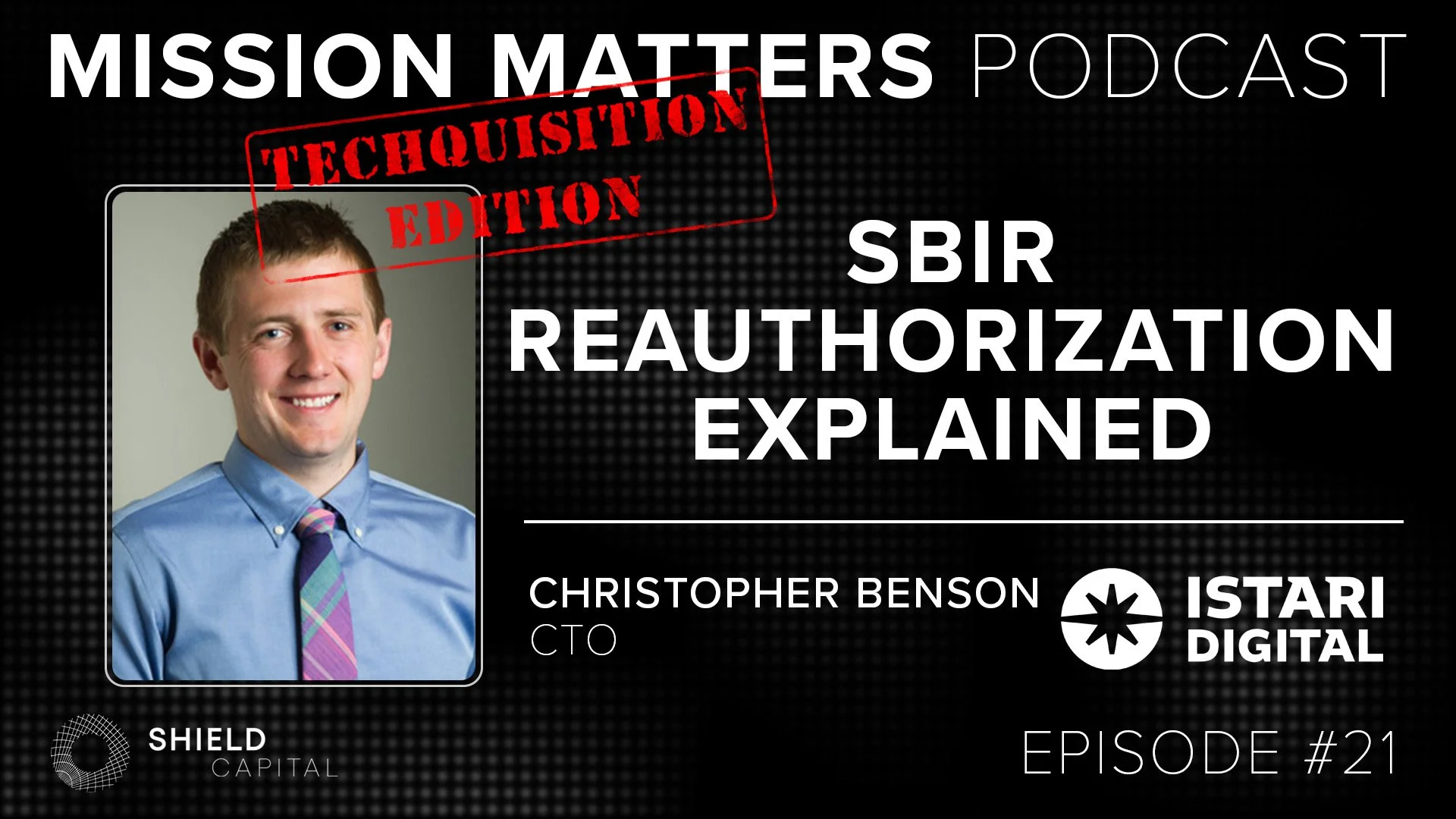
On this episode of the Techquisition Edition of the Mission Matters podcast, we’re breaking down something that really sits at the center of the defense innovation ecosystem — that is the reauthorization of the Small Business Innovation Research and Small Business Technology Transfer Program, better known as the SBIR/STTR program. Although, for the purposes of this podcast, we’re just going to truncate it down to SBIR, which is how it’s commonly referred to. Additionally, while SBIR is a government-wide program administered by the Small Business Administration and executed at every government agency, we are primarily going to focus on the Department of Defense, which we will just refer to as DoD. And to help us do that, we are joined by someone who has a front row seat to the evolution of the program — Chris Benson, the CTO of Istari Digital. Before joining Istari, Chris served as an Air Force acquisition pioneer and was one of the architects behind the modernization of SBIR during his time at AFWERX, including initiatives like creating the concept of open topic and the extremely popular TACFI/STRATFI program that many startups and investors today see as the best on-ramp into defense.
David 01:51
All right, Maggie, but before we bring Chris on, I think we should level set for our founders listening, because SBIR is one of those programs everyone in defense Tech has heard of but very few people fully understand exactly.
Maggie 02:05
You know, depending on who you talk to, SBIR is either the single most important funding source for early stage defense technology, or it's this useless bureaucratic maze like program buried somewhere deep inside the federal government. You know, I even heard somebody refer to it once as welfare for PhD students.
David 02:24
Well, that's some pretty good ramen. But I guess historically, you could say that both of those things have been true. But at its core, SBIR is the federal government's venture capital program for small businesses. Since its creation in 1982 it has invested more than 77 billion in research and development funding across over 33,000 startups or small businesses supporting everything from defense technologies to medical breakthroughs and importantly for founders, this isn't just grant money floating around Washington. SBIR is one of the primary mechanisms that the government actually uses to discover, test and transition emerging technologies into real programs of record.
David 03:06
But as you'll find out later in the podcast, the program has gone through some pretty dramatic changes over the past decade. For a long time, the SBIR program was mostly run out of government labs, places like Air Force Research Lab, Office of Naval Research, Army Research Lab, and until recently, not super conducive to venture backed startups, and candidly, has had a pretty poor track record in transitioning into meaningful war fighter capability. For years, most small businesses that received SBIR funding never meaningfully productized or deployed the technology that the SBIR program funded.
Maggie 03:43
But then things started to change,
David 03:45
So around the late 2000 10s, let's say 2016 2017 a group of acquisition leaders inside the Air Force, who I am proud to call my friends, including our guests today, began experimenting with new ways to use SBIR to attract these venture backed companies and start to transition the technology. They started with a simple idea like open topic, and upon success, opened up the aperture of funding and established the TACFI/STRATFI program,
Maggie 04:13
if you're a founder or investor in defense tech. Today, those programs probably sound pretty familiar.
David 04:20
So like those initiatives, essentially turned SBIR from a science project funding mechanism into something much closer to a commercialization pipeline, and now we're seeing Congress codify a lot of that evolution.
Maggie 04:33
So that brings us to the big news of today, after more than a year of debate and uncertainty, including a multi month lapse in the program when authorization lapsed back in September, Congress has finally passed the Small Business Innovation and Economic Security Act, which reauthorizes SBIR and STTR for five years through 2031
David 04:54
and in addition to extending the program, the bill also introduces several structural changes. Founders. Should understand, and we'll get into that a little bit later.
Maggie 05:04
All right, let's bring on our guest for today.
David 05:08
Well, it gives me great pleasure and pride to bring Chris Benson on, who is one of the key figures in modernizing the SBIR program during his time at AFWERX, which is the innovation arm of the Department of the Air Force, and he's helped shape reshape how the program engages startups
Maggie 05:24
today, he's on the other side of the table as CTO of Istari Digital, a fast growing dual use defense technology company that's also leveraged SBIR as part of its growth.
David 05:36
Chris, welcome to the Mission Matters Techquisition Edition podcast. We're so fortunate to have you on here. It's definitely great to have a friend and a colleague, and I guess, an Air Force veteran, maybe a quitter as well, join us here. Now that you're on the private sector side, I guess to start off when you were working inside AFWERX, helping evolve the SBIR program. What problem were you trying to solve then? And what wasn't working about SBIR at that time? Yeah.
Chris 06:09
Well, first off, thank you so much for having me, and I will second my excitement about the bill that was just passed by the Senate on Tuesday, and then we were just talking about what the House is about to do with that. So I think there’s a lot of really interesting things that are getting pushed forward. And I guess I’m very, very encouraged by Congress continuing to try to improve on the SBIR program. After, I guess, 40 plus years, there’s been a lot of improvements on it since we started working on it back in the 2016, ‘17, and ‘18 timeframe. So going back to your original question — what were we actually trying to do there? If you remember, during that timeframe, that was in the early days of, I would say, a wellspring or Cambrian explosion of many types of innovation organizations, right? So DIU, the original, which you were at, David, as well as a number of other folks. And then we had AFWERX, and then we had NavalX, and there were a few other organizations that were around there as well. And so at AFWERX, when we were working on this, we got brought in and were originally tasked with the idea of trying to encourage innovation within the Air Force. And so we tried to do a number of different things by focusing on individuals and empowering the airmen and the folks inside the organization. But then they also brought us some folks who were working on acquisition — who were acquisition officers — that would include myself and some others, to try to think about, well, what are some of the acquisition tools we have in our tool chest to be able to figure it out? And we — one of the first ones we looked at was the SBIR program. So at the time, that was several hundred million dollars a year of funding that was taken from a large number of different accounts and was spent through kind of a central process, through Air Force Research Lab. And the thing that we noticed with that, that was interesting, was the fact that the number of dollars that we had in that SBIR bucket every year was increasing, which is good, right? Okay, so this is more money for innovation, trying new things within the department. The thing that was concerning was that at the same time, with the dollars increasing, the number of unique companies that were being awarded was actually decreasing. And then so we dug a little bit deeper, and we realized that, oh, actually, not only was the number of companies being awarded decreasing, but the number of unique companies even applying for these ever-increasing number of dollars was decreasing. And so we saw this as a demand problem, or kind of a problem with the solution that we were offering to attract the best companies to work with us. The number one thing we were trying to solve is: if we are getting more dollars, how can we also get that to be given out to more unique types of companies and have more competition for those dollars? And so we went after a couple different things, and we saw really kind of two of the biggest challenges that we heard when we were talking with companies about why they were not coming and working with the SBIR program. The first one being that the process for how they were applying was rather opaque, and so they weren’t exactly sure what they were supposed to be doing with this. It wasn’t clear — there was a whole bunch of “you have to apply for a DUNS number, and you had to go get a SAM account” and all these different kinds of things. And so we tried to spend a lot of time making that process as transparent and as straightforward as possible. The other thing that I think is actually probably the most important one was it was just slow, right? So you would submit an application, you would wait. You would wait maybe three months, and then you would hear something back. Sometimes you would be selected; other times, we would wait six months, and then you might be hearing, “Hey, you’re selected” or “not selected.” And then you might wait another three months to start. And now it’s been nine months, and you’re starting a $150,000 phase one contract, and for a lot of these companies, the timeframe just didn’t work. The two big underlying problems we were trying to solve behind that were the clarity about how companies could engage with the government, and also the speed at which they could engage with the government through that process.
David 10:36
Yeah, that's great. And I think time to execution is often overlooked and maybe taken somewhat for granted with some of the more recent language and then sort of just the vigor with which AFWERX started to actually work with these companies, which has probably then increased the volume of participants. But you know, to me, I think when the SBIR program really came onto the scene was with this unique concept that you all came up with. And I think you highlighted, you know, the fact that the industry base was shrinking, right? We had less performers, despite the fact that there are more entrepreneurs in the United States than ever before, and yet somehow less are choosing not to participate in the national security environment. Of course, that was a big part of the reason why Defense Innovation Unit was stood up. But you guys kind of took it a step further, and you created this idea called open topic. Seemed pretty radical when it launched, yeah, and I can imagine that there was some pushback. So maybe you can talk a little bit about how you came up with the idea of the open topic. What were some of the reservations behind it? And then how have you seen that maybe proliferate across other parts of government?
Chris 11:52
It’s interesting that you mentioned that the open topic was novel, right? So actually, both the original things we were trying to do — moving fast and trying to have clarified instructions — we leveraged a lot of lessons learned from you all out of DIU to do that for the kind of overarching SBIR reform. And the open topic we actually leveraged from the British. So there was this organization called DASA — which I wish I could remember the full acronym for — in the UK, and they did these open calls for innovation. And so the original open call solicitation for AFWERX was modeled almost exactly off of the open call from the British. Now, you’re right. There was some pushback from folks saying, “Hey, you know, we’ve tried this before.” In the past, there actually had been a topic within AFWERX called a blue sky topic, and it had actually received zero applications in the past because people didn’t know what to apply to it. And that was, I think, in the early-to-mid 2000s or something like that. And so people were saying, “You know what? Fine, go ahead and try it. Last time we did this, we got zero applications.” And so it was actually interesting to see how they let us do it. But the real reason why we did the open topic was really, once again, trying to solve a particular need for the warfighter at the time, right? So we were seeing a bunch of companies — they were starting to apply, it was faster. There were a bunch of companies saying, “Okay, I have this capability. It doesn’t fit in any of the buckets that you guys have, any of the topics that are currently out there.” And I was like, “Okay, well, you’ve got to get to talk to somebody who’s writing these topics — a warfighter, if you will.” And they’d go, “Yeah, no, I have a warfighter. He really wants it.” And they would find an actual operator, right? Who really wanted the solution. But then we realized there was actually a timeline problem, not just post submission of the application, but beforehand. So there was this process where, in order to get into a specific topic we had at the time, you would submit an idea for what an SBIR topic would be, and you could wait — I don’t know, I think between when you submitted the idea, it would go through several gates and checks, which made some sense. But between when I submitted it as a warfighter, or usually as an acquisition person, and when it actually hit the streets for companies to see it, that was between six and 12 months, right? So now add it up. I’ve got an idea as a warfighter, a need as a warfighter or an acquisition person. Now I’ve got to wait, let’s say, 12 months until it actually hits the street. It’s going to be open for one to three months. So now we’re at 15 months. And now between when somebody submits their proposal and they’re actually starting a contract, that’s another nine months. So now we’re at 24 months from when the warfighter has a need. And that is completely outside of the realm of what we were being asked to do by our leadership — which was to move fast. And so we said, “Well, look. If you’ve got somebody who really wants it, then how about you just have them write a letter saying, ‘Hey, I could actually really use this.’ And what if we made a topic that said, ‘All right, if you’ve got somebody who really wants to use something, you’ve got a really interesting idea — then let’s just have an open topic for things that really need to move fast and have a really serious defense need, have some good technical backing, and have a real pathway to commercialization.’”
Maggie 15:23
So Chris, another initiative I know that you worked on at AFWERX was the TACFI/STRATFI programs, and now we see in this new reauthorization bill the Strategic Breakthrough Awards, which award up to $30 million for phase twos. They look very similar to STRATFI in that they have the idea of matching government funding with private capital. So I’m curious, can you talk a little bit about what you were trying to accomplish with TACFI/STRATFI at AFWERX, and now that we see the Strategicbreakthrough award, do you see this as Congress basically institutionalizing that model that you initially pioneered?
Chris 16:01
But, yeah, I think the Strategic Breakthrough Awards are definitely, I think, the spiritual successor of what we started in the beginning with TACFI and STRATFI. And I’ll go back to why we did that originally. It was because we had warfighters, we had acquisition folks who had a demand, right? They came in and said, “All right, well, look, I can write you a letter, and we can get on a phase one or a phase two. But really, in order to make something that’s truly useful at scale — that can cross that valley of death — $2 million is actually not going to cut it.” I mean, some of these programs that go into production — $2 million is a rounding error on some of these very large things. And so we had some folks from the acquisition community who would come and say, “Hey, look, I’ve got a warfighter. I’ve got some money, but $2 million is not enough.” And so we said, “Well, unfortunately, we can’t write that big of contracts.” And then, fortunately, in that case, I was wrong. We went back and looked at it, and it turns out you actually could write larger SBIR contracts if you were able to work with the Small Business Administration to prove to them that, “Hey, this is actually a good use of the SBIR funds, and you’re not concentrating it for no reason.” And so part of our discussion with the folks and a lot of different stakeholders working with the SBIR program and the STTR program at the time was saying, “Hey, look, we are okay with you guys trialing out writing larger awards for things that you think can make strategic impacts for the warfighter or for a particular acquisition. But we don’t feel like it’s right, and we don’t think it’s necessarily the right answer to have the SBIR program take on all of that risk. If there really is going to be a transition, then what you don’t want to do is say, ‘Okay, fine, SBIR program, you build the entire bridge across the valley of death, and we’ll just meet you on the other side — on acquisition land over here.’” Rather, what we said is, “Well, look, how about this? The SBIR program could build a little bridge from one side, and the acquisition folks can build a little bridge from the other side — we can kind of meet in the middle. That way, there’s some skin in the game as you go across.” And that kind of narrative, I think, made a lot of sense to all the stakeholders at the time. And they said yes. And then one thing that actually kind of ended up fitting in the middle is: what if there’s just not enough money? It’s a really hard thing. But actually, private capital can come in, and it ended up working quite well. I mean, I don’t know the transition rate for a lot of the STRATFIs, but I know personally, I think of the first 20 or so, we’re easily in the mid double digits in terms of percentages that are actually transitioning over to programs of record, and that’s what you want, right? You want to be able to place these big bets, to have actual significant changes to how we’re approaching the valley of death and bringing new capabilities to the warfighter.
David 18:55
Yeah, that’s great. So I guess real quick on that — was the leveraging of third-party capital or VC funding not necessarily part of the original recipe when thinking about building larger STRATFI awards?
Chris 19:11
So it was both. When we were talking with folks from the SBIR and STTR offices, they were very focused on commercialization, right? It’s a core commercialization program. They were saying, “Hey, look, we want — if we’re going to put X number of SBIR dollars in there, we want to see you commercialize.” Now, commercialization can happen either through selling to somebody else in the Department of Defense, or selling to somebody like a large defense prime or even a commercial company. And so the — it’s not a perfect measure, but a useful heuristic — is basically non-SBIR dollars to SBIR dollars. And so we found the addition of private capital from, you know, places like venture capital firms or other types of investment firms to be a very useful indicator of the probability of transition to commercialization, whether it’s within the DoD or elsewhere. And it also has the added benefit of saying, “Hey, if I can put in $1 of SBIR, I can actually get two or three or $4 worth of capability.” And what we found actually — if you go back and look at the numbers — I remember we had this chart where it’s like, we would put some money in for all the STRATFI companies, and then very quickly after that, the amount of money they would get from all other sources combined would dwarf the amount of SBIR dollars. And so it was really trying to crowd in that funding — for the political scientists out there, it’s like the idea of: you put a little money in there and it acts as a catalyst to crowd in the other funds. That’s what we were looking to do. And we saw — I mean, I was blown away by the first response to the first open call, and it really was a huge, overwhelming response, both from the private investment community and from the warfighters.
David 21:00
Yeah, no, that’s awesome. Well, so Chris, you know you’re now on the other side as CTO of Istari Digital, building a dual-use defense tech company. Have you been a user of the SBIR program, and what’s it like being on the other side of the table leveraging some of these programs that you helped institutionalize?
Chris 21:20
I mean, I think we like to practice what we preach, right? And so we think that starting with some of those early phase one, phase two pitch day-type SBIR awards, and then as soon as you’re getting on those awards, immediately start thinking about that transition — both to where you’re going to get the non-SBIR dollars and getting over into the commercial sector as well. And I mean, I remember our very first — when our first SBIR phase two started, my first conversation with our program manager was like, “Hey, look, this is only meant to get you in the door. We want to be focusing right now on how to cross the valley of death.” And so we went through the exact same pathway. We kind of mapped out where we started with a couple of those doing this STRATFI, and we have now kind of transitioned out of leveraging heavily SBIR dollars, certainly the last couple of years, but it was very helpful in the first couple to get us off the ground. So the focus now — I always tell startups: “Hey, look, there’s kind of two different go-to-market motions when you’re working in the federal areas. The first is getting in and getting your initial foot in the door, and the second one is going and getting your production contracts.” So the initial ones are phase ones and phase twos; the ones further out are going to be production contracts, and hopefully you’re leveraging the SBIR phase three rights. I will say that I don’t think I’ve seen a lot of people talking about all the stuff the Senate passed — and the Strategic Breakthrough Awards are really, really cool. Love all these things. I think that’s certainly one of the things I’m most excited about.But a sneakily important aspect, I think, of the bill that was passed yesterday was the fact that there’s a requirement for agencies to have templates for the phase three contracts. One of the biggest challenges we still see today in 2026 is the fact that a lot of contracting officers are still not comfortable writing contracts or transactions using SBIR phase three authorities. And the more folks can get comfortable with that, I think the more you’ll see folks be able to transition those things across the valley of death. And so that’s a sneaky, kind of under-heralded part of the bill that came through, from my perspective as well.
Maggie 23:41
So Chris for founders listening, how should they think about SBIR today? What advice do you have for founders to best take advantage of this program?
Chris 23:51
Just know that as soon as you start that first go-to-market motion of getting your foot in the door, you need to start immediately building that muscle of moving to production. You need to start having those conversations right away — talking with the warfighter or program managers about this: “How are we transitioning this? Where’s the PEO line where the funding is coming from? Let’s start talking about SBIR phase three, or production follow-ons, or whatever else you may want to be going through.” And just know that’s a different set of skills than getting your foot in the door. But I will still say that, between what they’re doing with the SBIR program and what David was able to create at DIU, I don’t think there’s been a better time for startups in general to get their foot in the door. But once you get your foot in the door, you immediately need to change your mindset and start focusing on that transition to production.
David 24:43
Oh, absolutely. So I think, yes, production and scaling, that is how we all win. That is how the startups sort of showcase their value. It's how the war fighters get access to compelling technology with economies of scale. And I mean the ultimately, I think, the taxpayer, you know. Gets better leverage on on what they're paying in for government operations. So Chris, it's always a treat to reconnect with you. You know, I should also shout out that Chris is part of the inspiration around sweat equity. So if you read my blog on that, you'll have noticed his name being mentioned there as well. And you know, you are just kind of, you're not going to beat me in the beep test this year. Fine. We can do the two-mile race then, I don’t know.
David 25:33
We’ll see — perfect, on reserve duty. Well, Chris, thanks again. Appreciate your time here. Appreciate everything that you’ve done for the SBIR program — taking it out of the doldrums of backwater lab work and into the forefront of innovative, cutting-edge technology. We salute you for that, and thanks for coming on this episode of the Techquisition Edition. Thanks, Chris. Awesome.
Maggie 26:01
now that we've heard a little bit about the history of the SBIR program from Chris and how the program came to be such an important part of the defense ecosystem today. Now let's turn to discuss some of the major changes that were made to the program in the recent SBIR reauthorization bill. So first, one of the big changes made in this bill was that Congress created something called strategic Breakthrough Awards, which allow phase two SBIR projects to scale up to as much as $30 million over four years, provided the company can bring matching funds from another government agency or third party capital provider.
David 26:40
And as you learned, it seems that the origin definitely came from the TACFI/STRATFI model that AFWERX pioneered. So this is the government trying to pair funding from other sources and help accelerate transition, whether that’s with private capital or other government funding.
Maggie 27:00
So the idea there basically is, if I can go get another DoD agency to give me $10 million to fund some project, then I can get another 10 million from SBIR. Is that the right way to think about this?
David 27:14
I think so, yeah. It’s all about — and in certain cases, it’s also looking towards the future. So if you are addressing something that has future funding programmed, you can win a STRATFI now — that funding doesn’t come to you until you’ve exercised that milestone and the matching funding has also been released. But yes, it is all about big-time signaling and leveraging other pots of funding.
Maggie 27:42
Another major change that founders will notice is proposal limits. Agencies now have the authority to cap how many SBIR proposals a single company can submit in one year, which reads like an attempt to prevent what people sometimes call SBIR mills, right?
David 27:58
You are right, Maggie. I mean, it’ll be interesting to see how this one plays out. I certainly feel for the government SBIR evaluators, who are deluged with proposals, and you know, advances in AI mean larger volume proposals — a lot of it being AI slop — and that is a pretty big drain on your evaluators trying to separate the best solutions from the rest. My personal hope is that this will help curb the SBIR mill enthusiasm for submitting to every topic under the sun, even when they’re unqualified. But time will tell, and the agencies will exercise their own autonomy around this. I think it’s also worth noting — and Chris alluded to this in the interview — around improvements for phase three transitions, including some standardized procedures and better acquisition workforce training, so that contracting officers can understand how SBIR technologies can be fielded beyond R&D funding. And like anything, you know, education is absolutely key, and it is a great authority that the SBIR program provides to help companies transition from these R&D stages into something that looks more like production.
Maggie 29:11
And then there's another area that's recently gotten a lot of attention that is foreign due diligence.
David 29:20
Yeah, this is a big one. Congress has significantly expanded security screening requirements for companies participating in the SBIR program.
Maggie 29:29
So David, help founders understand what that actually means. You know, if I'm a startup applying for SBIR funding today, what kind of scrutiny should I expect?
David 29:39
Yeah, this is probably the biggest structural change for founders that they need to understand. Congress has essentially expanded the national security screening process for SBIR participants. Under the new rules, agencies now have to conduct due diligence on companies applying for SBIR funding to determine whether they pose a security risk. The government will evaluate things like financial, employment, or technological connections with foreign entities, and whether the company or its partners appear on a number of national security watch lists such as the Commerce Department’s Entity List and the Treasury Department’s Chinese military-industrial companies list. So for founders, the takeaway is pretty simple. SBIR is still very much open to venture-backed startups, including those with international investors, but transparency around ownership, capital sources, and foreign relationships is going to matter a lot more. And if there’s a questionable connection to entities in countries of concern, the agency now has the explicit prerogative to deny such awards.
Maggie 30:43
So we've covered what changes made it into this SBIR reauthorization bill, but I also want to discuss what didn't make it in. There's been a lot of debate over the last year about SBIR reform. I know David last year, you actually testified in front of the Senate Small Business Committee right as Senator Ernst unveiled the Innovate act to institute more substantial reform of the SBIR program. What were some of the key provisions in this bill that were not passed in the final bill, or what were you hoping might make it through that was ultimately left on the sidelines?
David 31:16
Yeah, good point. And you know, it probably doesn't do any good to dwell in the past, but a couple elements that Senator Ernst included was this unique phase one, a program which was aimed at helping new entrants on ramp faster into the SBIR program. So it was almost like a carve out before a phase one, and it was only available to first time participants that did not make it into this final bill. Additionally innovate act, wanted to apply a lifetime cap for how much funding an individual company could win through the SBIR program that also did not make it in. And then, personally, I had hoped for some language promoting firm fixed price contract types over cost reimbursement, or at least giving a significant preference from Congress that isn't in there either. Though I do feel good about a lot of different agencies across the DoD who seem keen on trying to promote firm fixed price, which is far more conducive to a venture backed startup, and you know, just more aligned with how the commercial world does buying in general.
Maggie 32:27
Well, regardless, I think we’re all happy that SBIR is officially reauthorized. The wait is over, and that just means there’s going to be more innovative small businesses getting funding to build the future of defense innovation, which I personally am excited about.
David 32:44
absolutely, and I can maybe stop fielding calls from founders and other investors about what's going on with the latest with the SBIR at least for the next five years, we don't have to think about that authority going away, though. I'm sure you know, in four years, we'll start to re engage and and see how we can make this program even more conducive to just the way technology is developed and where the national security apparatus needs it. So I guess the battle is over for now, but modernization never sleeps.
Maggie 33:18
All right, David, as we wrap up, I want to ask you a closing question. What do you think the next Techquisition Edition episode will be about? If you had to guess?
David 33:28
Okay, great. I did think, I think we got this one correct.
Maggie 33:33
We did get this one correct. We correctly guessed SBIR reauthorization was next. So let’s see if we can keep the streak going.
David 33:39
Well, yeah, and the other one that I think I alluded to was around the President’s budget, so we’ll see if that one transpires, but that’s what I believe will be the next Techquisition Edition.